Custom cultured marble vanity tops are increasingly specified for large-scale commercial developments, hospitality rollouts, and multi-family housing projects where standard dimensions often do not fit the design requirements. Architects frequently specify non-standard vanity tops to maximize space and meet unique design aesthetics. However, transitioning a CAD drawing into a physical, high-volume production run presents a critical sourcing challenge.
For business owners, project directors, and procurement teams evaluating overseas suppliers, the number one concern is an unreliable supply chain causing severe project delays. An unpredictable supplier that relies on third-party tooling shops often struggles with extended lead times, slow revisions, and miscommunications. When a critical component like a custom vanity top is delayed at the mold-making stage, it forces a complete standstill for your on-site assembly teams, driving up labor costs and threatening the entire project schedule.
Many procurement teams focus heavily on the final casting material, overlooking the foundational phase of production: the tooling. This article explains why the mold dictates the ultimate success of a custom vanity top, and details our in-house tooling process from drawing to finished part to help protect your delivery timeline.
1. Custom Cultured Marble Vanity Tops: From CAD Drawing to In-House Mold Production
In the manufacturing of Cultured Marble, the mold is not simply a container — it is the blueprint of the final product. The structural integrity, dimensional accuracy, and surface finish of a vanity top are determined long before the first drop of material is poured.
When project managers rely on outsourced tooling workshops, they introduce variables into their supply chain. A mold that deviates even slightly will result in vanity tops that require labor-intensive on-site modifications to fit pre-fabricated cabinets. If the mold’s surface is improperly finished, the final product can also suffer uneven gel-coat distribution, affecting its non-porous surface and long-term durability.
To manage these risks and secure a fixed delivery schedule, quality needs to be controlled from the ground up — through an in-house tooling process.
2. The 5-Step Custom Mold-Making Process
The tooling process begins with our Engineering Team translating your required dimensions into a 3D mold design, ensuring that the finished mold will release cleanly. Before finalizing the blueprint, they strictly verify overall dimensions, drain placement, edge profiles, and integration points for the integral backsplash to align perfectly with the architect’s vision.
Once the 3D design is locked, the physical execution on our factory floor follows these 5 strictly controlled steps:
Step 1: Precision Mold Fabrication
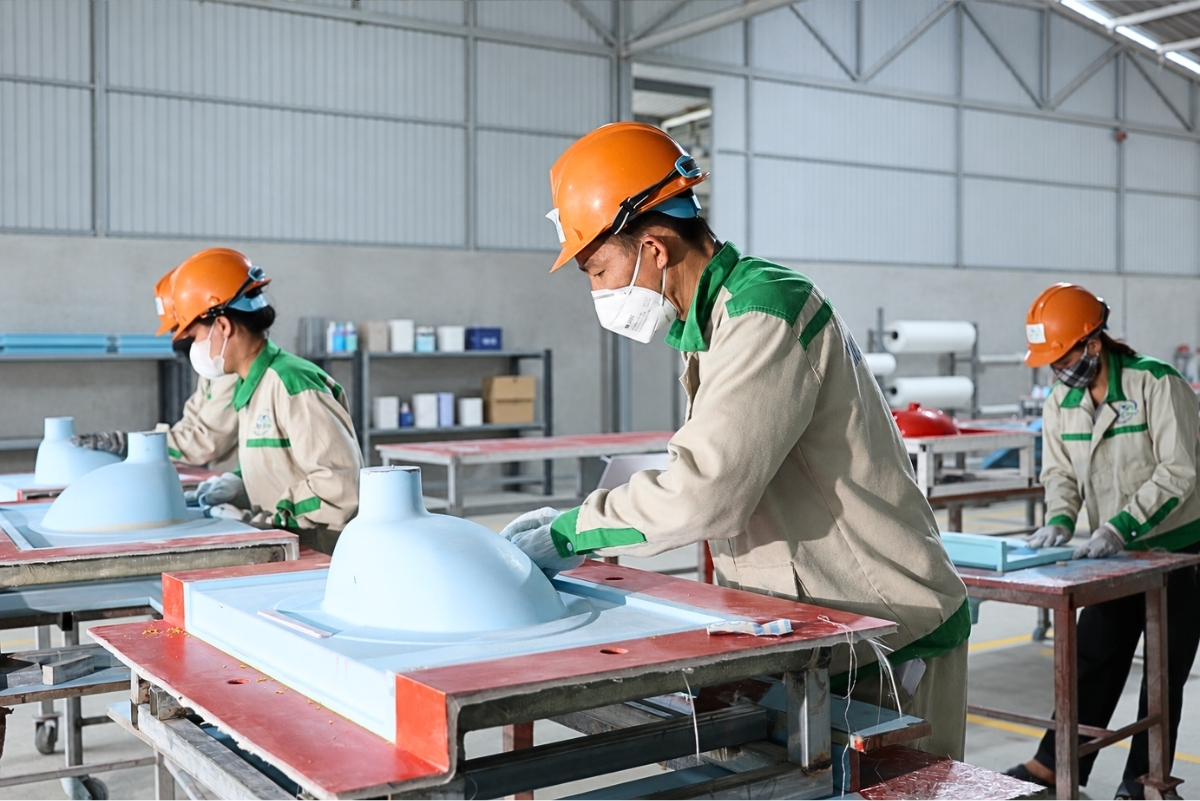
The mold is CNC-machined directly from the approved 3D model. Our dedicated fabrication unit meticulously checks the mold’s frame dimensions to ensure it precisely matches the required non-standard specifications before any surface work begins.
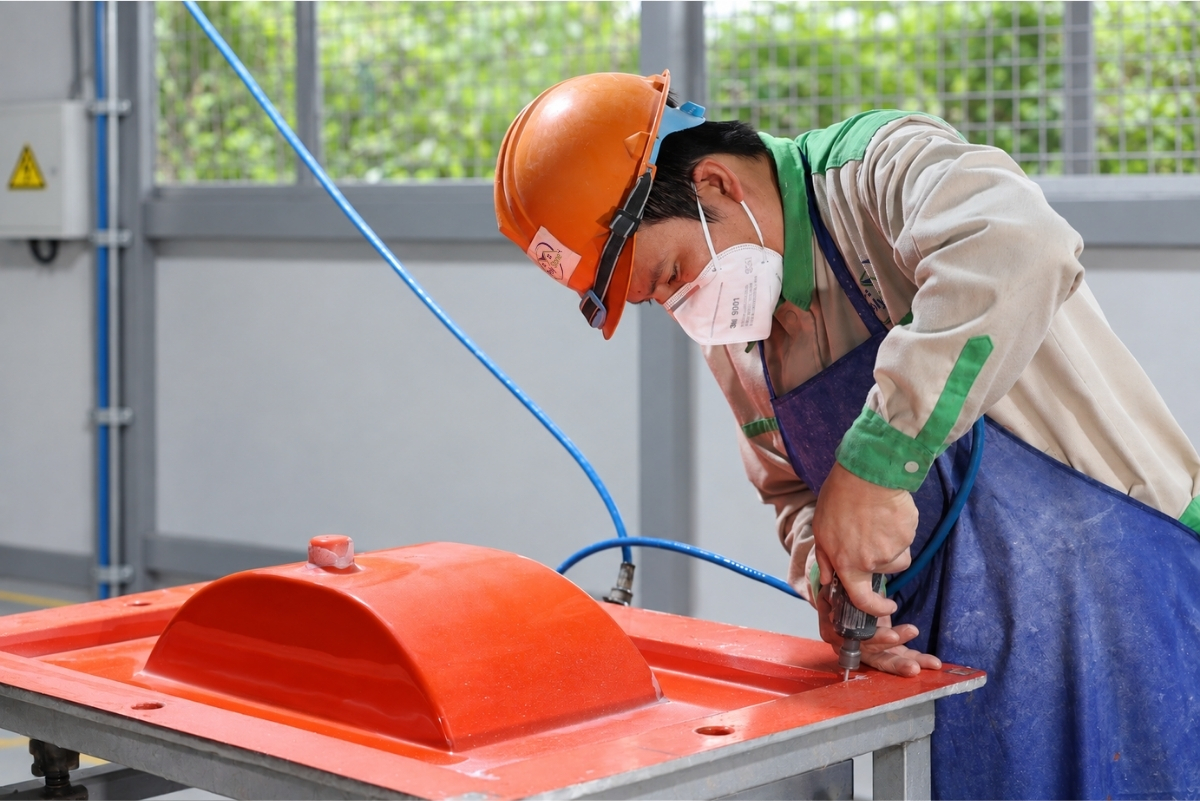
Step 2: Surface Calibration and Finishing
Because the smoothness of the mold’s interior face directly mirrors the final finish of the vanity top, surface calibration is critical. The mold surface is rigorously sanded, polished, and treated with a release coating to achieve the smoothness that determines the vanity top’s high-gloss (>80GU) finish.
Step 3: Gel-Coat Application
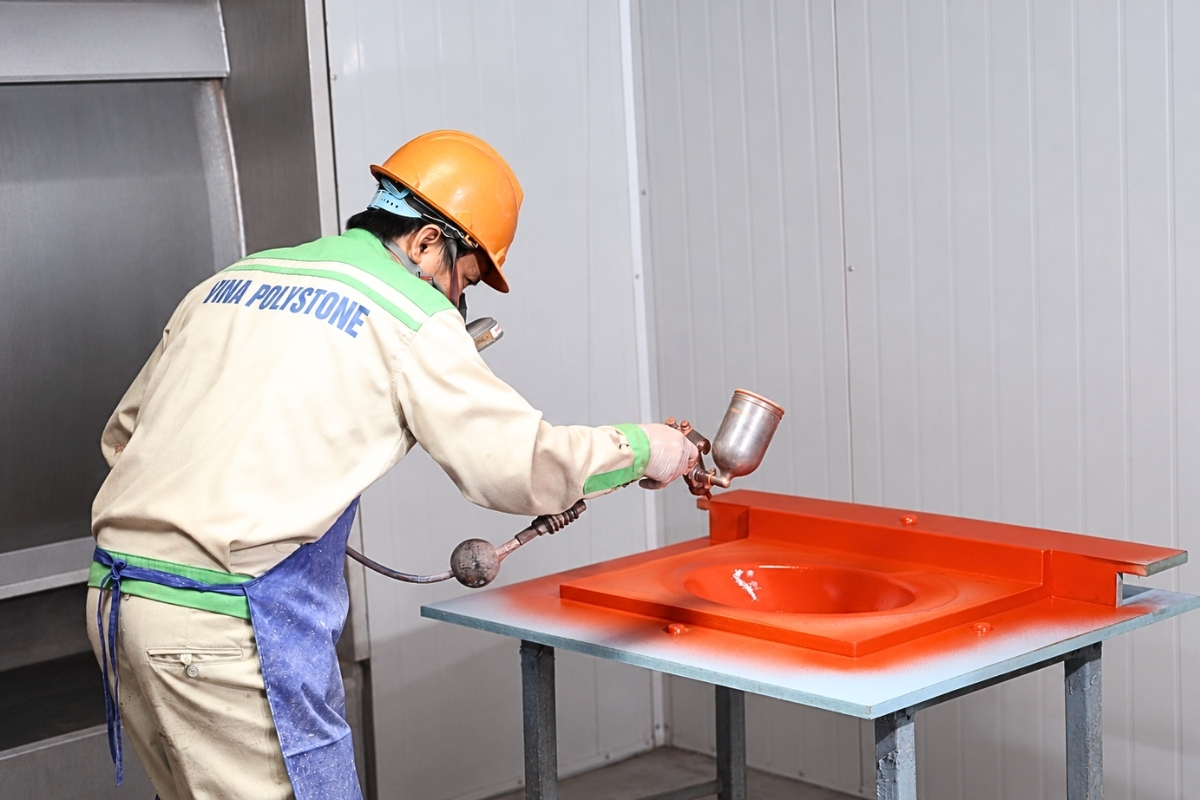
The mold itself is then prepared for structural reinforcement. Two precise layers of gel-coat (0.6–0.8mm) are sprayed evenly onto the mold surface to form a durable protective barrier.
Step 4: Structural Fiberglass Reinforcement
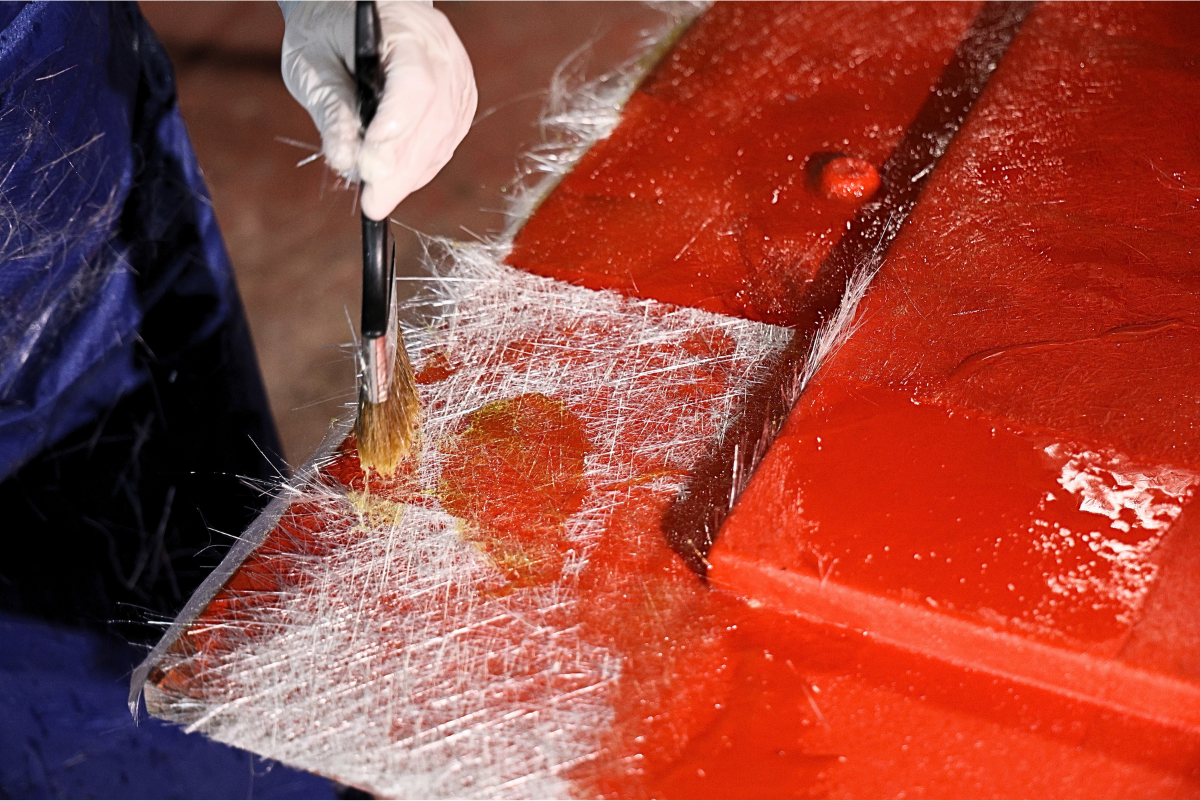
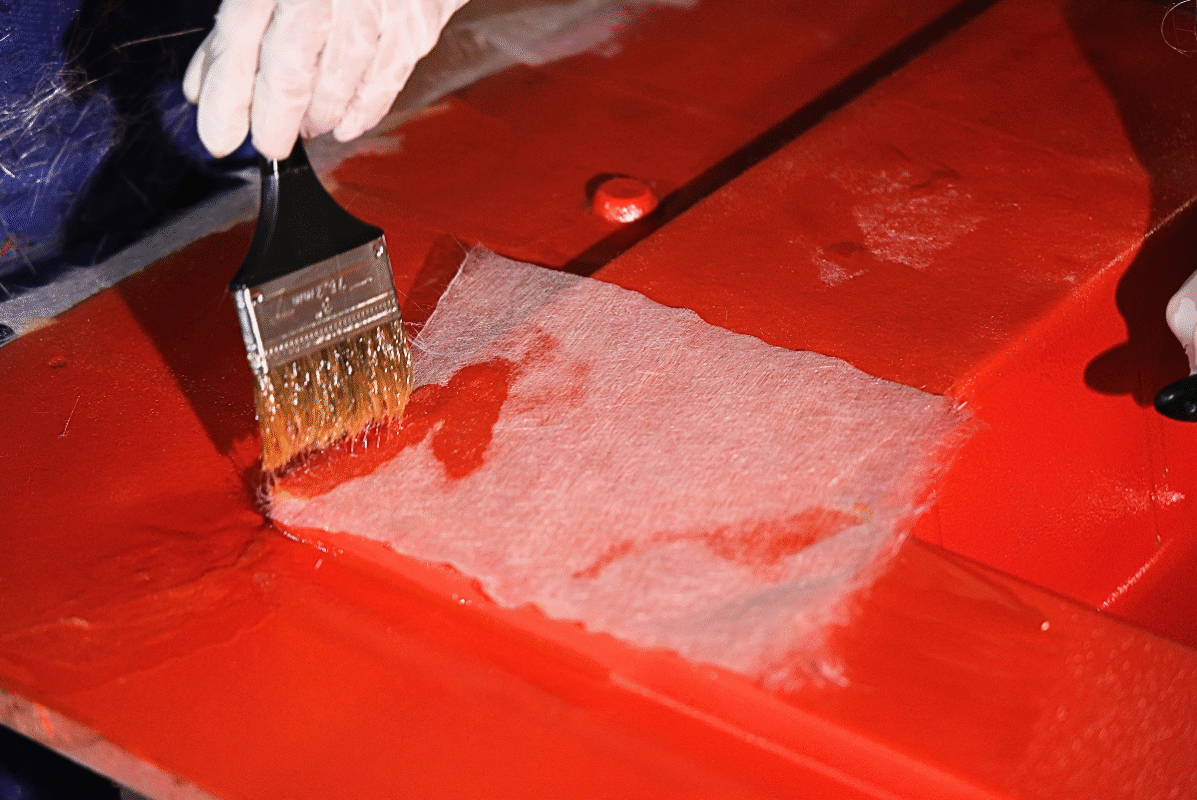
Once the gel-coat has cured, our technicians apply 10 to 12 layers of fiberglass reinforcement (building up systematically from the first foundational layer to the final heavy-duty layers) — this is what gives the mold the structural durability to be reused across the full production run.
Step 5: Final Validation & Trial Casting
Before mass production initiates, the finished mold undergoes a strict handover inspection. A trial piece is cast under actual production conditions, and our QC team comprehensively verifies the fit, confirms dimensional accuracy against the original CAD drawing, and conducts thermal shock testing to validate structural integrity.
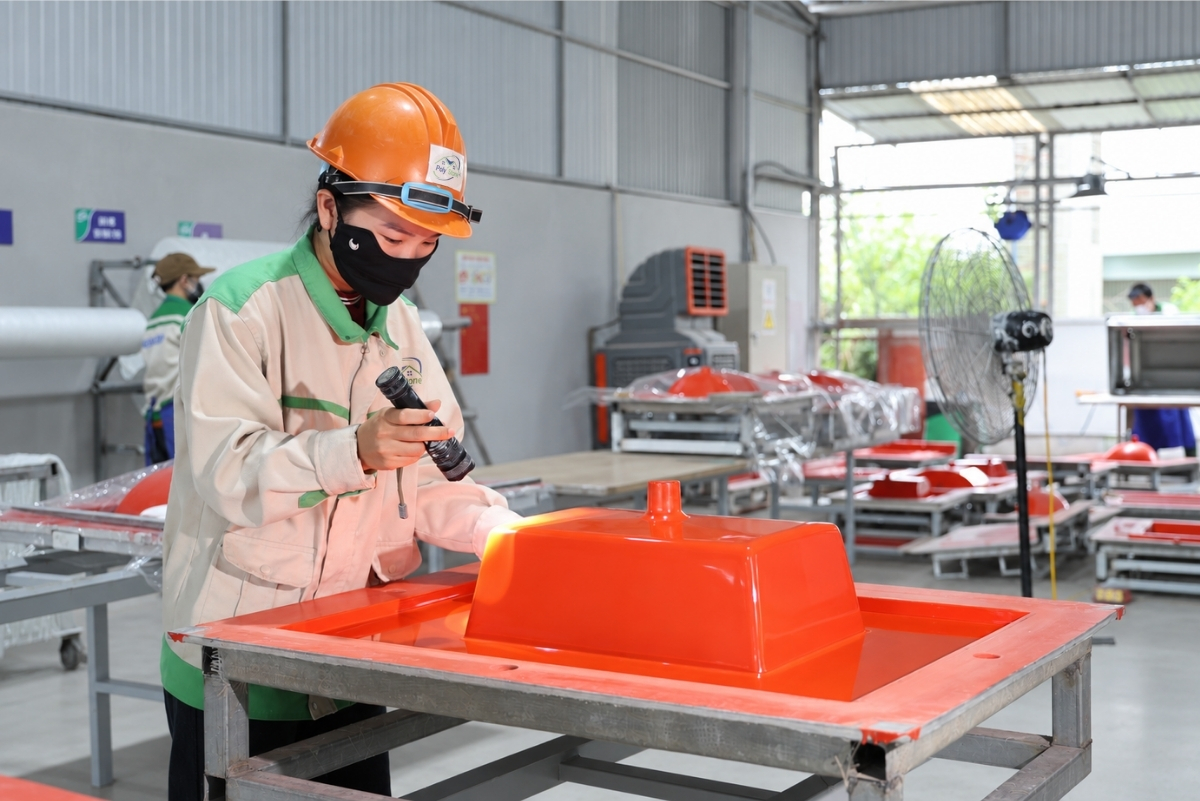
3. How In-House Tooling Affects Delivery Schedules and Consistency
Engineering molds internally changes the reliability of the supply chain. When a manufacturer depends on an external mold workshop, any revision to a non-standard size requires back-and-forth communication that can add weeks to the lead time.
By fabricating molds entirely in-house, we remove that dependency. If a dimensional adjustment is needed, our engineers can act on it directly on the factory floor. Controlling the mold internally also helps us hold dimensional consistency across a production run — so units arrive at the job site ready to install, without on-site rework. Each mold is engineered to support a full run of 500 to 800 units, giving buyers a clear, stable basis for planning order volume without unplanned retooling delays.
4. What ‘Made in Vietnam’ Means at PolyStone
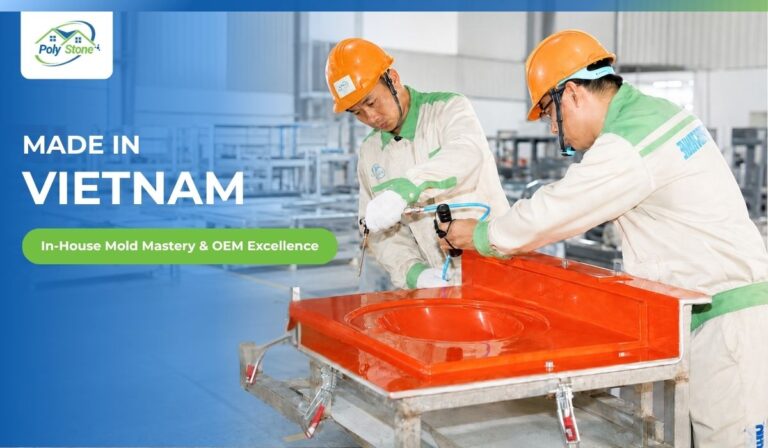
For North American buyers, sourcing internationally takes more than a competitive price — it takes a transparent, controlled supply chain. At PolyStone, our ‘Made in Vietnam’ approach starts with the raw material: high-purity limestone (CaCO3 powder) sourced from Nghe An, Vietnam, paired with our own in-house molds for seamless, one-piece casting.
Our production is certified to cUPC standards and built to meet the safety expectations of the U.S. and Canadian markets. Every commercial order is packed in reinforced export crating that meets ISTA 3A drop-test standards, reducing the risk of transit damage.
That combination — controlled raw material, in-house tooling, and export-ready packing — is what ‘Made in Vietnam’ means at PolyStone.
5. Secure Your Custom Commercial Project Today
Don’t let outsourced tooling become the bottleneck in your commercial project. If your upcoming development calls for non-standard sizes and strict tolerances, partner with a manufacturer that controls the engineering in-house, from drawing to finished part.
Send your CAD drawings and project specifications directly to our export engineering team — we’ll review your dimensions and provide a tooling and production quote.
Follow PolyStone’s LinkedIn to get the latest news!